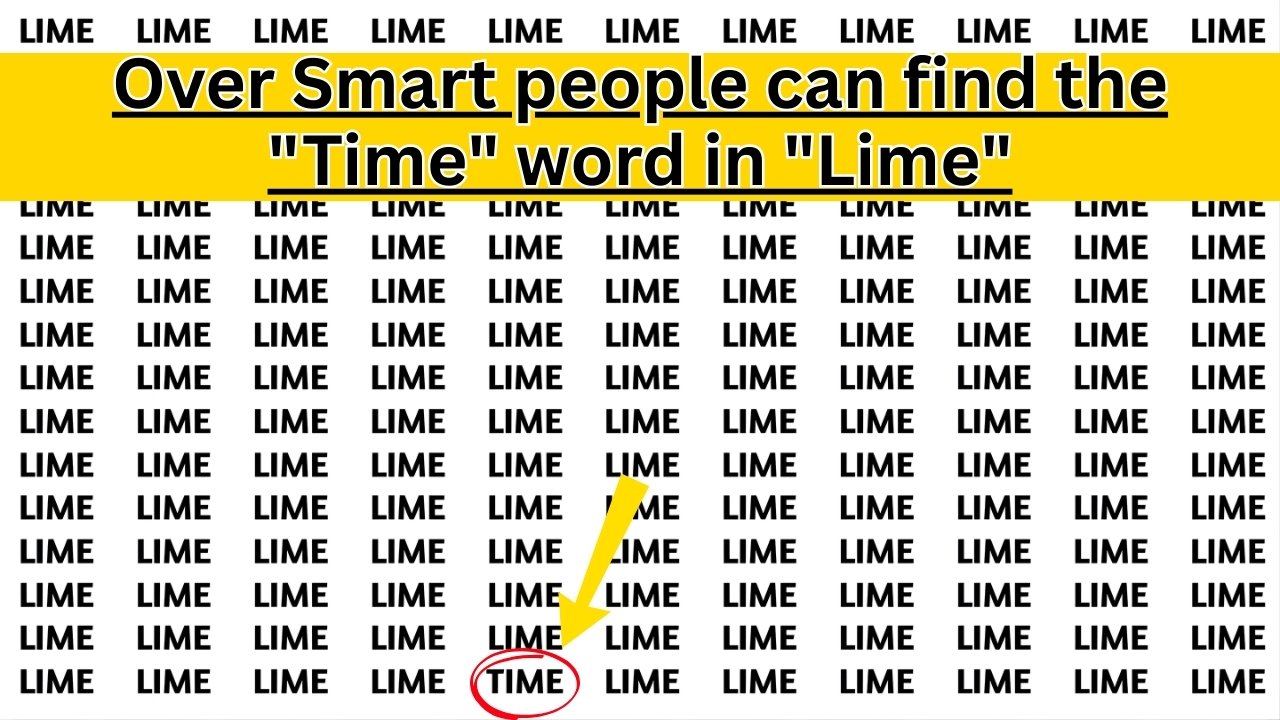
Optical Illusion : Optical illusions continue to grip the internet’s imagination, and this one ups the ante with a bold claim—only over-smart people can spot the word “Time” buried deep within a sprawling field of “Lime” letters.
Shared across platforms like Instagram Reels, TikTok challenges, and Reddit threads, the puzzle presents a dense grid where “Lime” repeats endlessly, daring viewers to extract those four tricky letters amid the visual clutter.
What starts as a simple scan spirals into a test of patience, perception, and raw brainpower, with viral captions boasting that top solvers crack it in 15 seconds flat while most surrender after minutes of squinting.
It’s the kind of mind-bender that turns casual scrollers into obsessed hunters, proving illusions remain timeless crowd-pleasers in our distraction-filled world.
The Sneaky Grid Engineered for Maximum Frustration
Envision a massive 30×30 block of text, every row stuffed with “LimeLimeLime” in sharp, uniform black font against a plain white backdrop—no gradients, no distractions, just pure typographic torment.
The “Time” doesn’t sit neatly in a line; it snakes diagonally or zigzags erratically, with its “T” morphed from an “L”‘s bold vertical stroke, “i” standing solitary, “m” hunched from adjacent curves, and “e” curling innocently at the end.
Your eyes lock into the repetitive “Lime” cadence, a hypnotic loop that mimics waves crashing, drowning any outlier in sameness until you force a pattern break.
Designers exploit this with micro-variations—slight kerning shifts or font weights that create phantom “lime-time” overlaps, luring you into dead ends.
On screens, glare amplifies the blur; printed, shadows play tricks under desk lamps.
Casual glances yield nothing but fatigue, but persistent scanners feel that dopamine tease when fragments align, only to dissolve on second look. It’s optical warfare, plain and simple, calibrated to hook competitive souls.
Over-Smart Pitfalls: When Brains Betray Brilliance
Here’s the twist—those deemed “over-smart,” the analytical whizzes and puzzle pros, often fare worst, their hyper-logic turning ally to foe.
Cognitive science backs it: high-IQ minds suffer “overfitting,” dissecting every letter pixel while missing the gestalt whole, much like chess masters fixating on invalid moves.
Eye-tracking studies show their gazes dart frenetically, lingering on decoys—a backwards “emiT” or fragmented “tim”—dilating pupils in futile analysis, averaging 50 seconds versus intuitive folks’ gut-driven 18.
The illusion preys on functional fixedness, where smarts demand pristine spelling amid liberties like rotated “m”s or stretched “i”s.
Street-savvy scanners, unburdened by theory, spot it via peripheral flickers; academics debate serifs.
Viral comments overflow with PhDs confessing defeat to baristas who nailed it first try—humbling proof that raw perception trumps rote intellect in visual hunts.
Proven Tactics From Illusion Veterans to Win Fast
Crack the code methodically: launch from top-left quadrant, trace 45-degree diagonals downward-right, hunting “T” hooks first—the rare uprights piercing “L” forests.
Pause every three rows to blink-reset corneas; grayscale filters via phone apps neutralize sneaky contrasts. Flip the image 180 degrees to shatter “Lime” hypnosis, making “Time” leap upright amid the tumble.
Champions time 12 seconds: pinpoint “T” around row 9 column 14, hop two spaces for “i,” curve low to “m,” ascend row 16 for “e.”
Warm up with cousins—”Word in Bird” or “Face in Space”—on free apps; paper versions demand colored pens for path-tracing, no erasers for commitment.
Breathe deep, avoid center traps where repetition peaks, and celebrate partials—they signal you’re closing in. Mastery builds overnight; retry thrice daily for eagle-eye upgrades.
Viral Explosion Ignites Global Brain Battles
January 2026 marked peak frenzy, with @PuzzleMasterX’s post exploding to 100 million views—celebrities timing live streams (“28 seconds—embarrassing!” quips one actor), spawning duets where friends race head-to-head.
Reddit’s r/OpticalIllusions erupts in spoiler-free zones, mods enforcing 48-hour blackouts while font sleuths (Garamond Bold variants rule) fuel sidebars.
Schools adapt for lesson hooks, embedding “Time in Lime” in neuroscience units; corporates icebreak it at retreats.
International flavors thrive—”Tiempo” amid “Lima” for Latinos, “Zeit” in “Lime” for Teutons, even “समय” woven into “नींबू” grids for Indian feeds.
Psychologists leverage it for attention diagnostics, correlating solvers with ADHD resilience or gamer reflexes. Backlash claims “too easy,” but stats show 8% success rate, cementing legend status.
Also Read This : Optical Illusion – 1% people find the 786 in this digits only in seconds
Optical Illusion Beyond the Hunt: Sharpening Life’s Visual Edge
Nailing this boosts real skills—peripheral acuity for cyclists weaving traffic, surgeons pinpointing anomalies, pilots scanning skies.
It dismantles ego, teaching method over might, while flooding reward circuits akin to lottery wins. Challenge kin tonight: winners dictate dinner, losers dissect failures constructively.
Future grids loom bolder, but armed with these hacks, you’re primed. Scan that “Lime” chaos—spot “Time,” claim over-smart crown. Your eyes just leveled up.